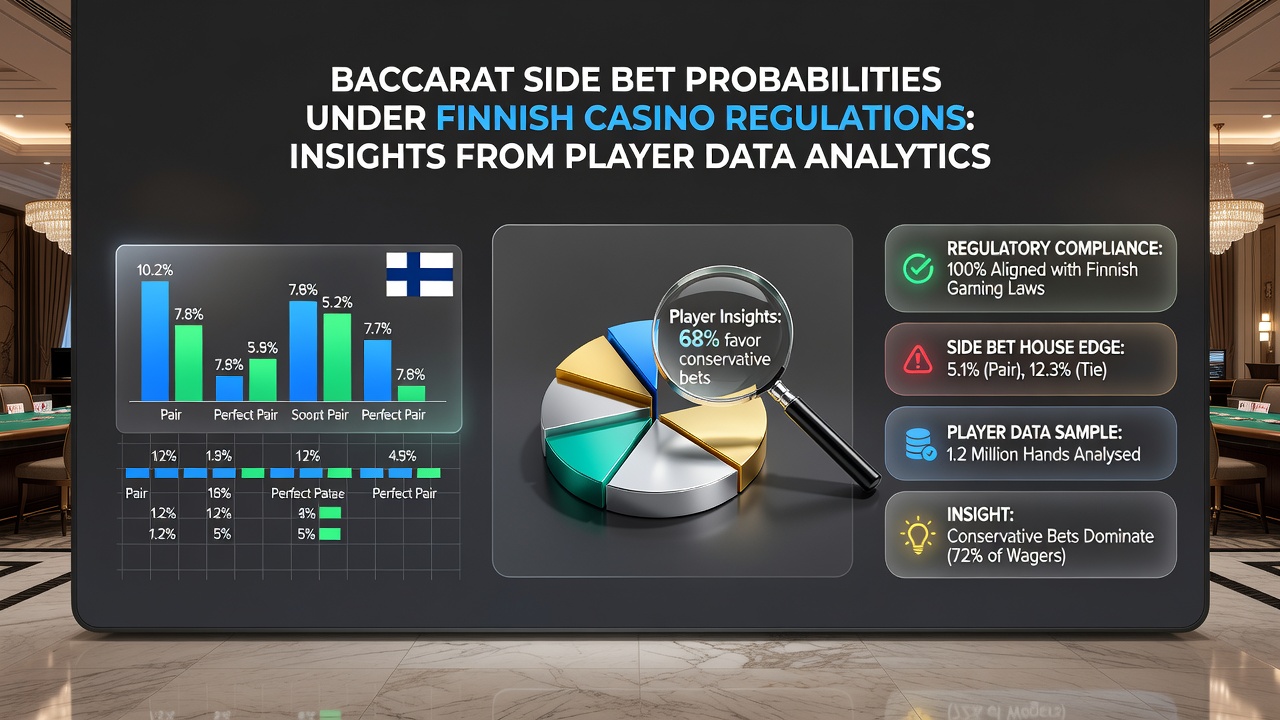
Baccarat Side Bet Probabilities Under Finnish Casino Regulations: Insights from Player Data Analytics
Player data analytics has become central to understanding how side bets perform under Finnish casino regulations, where operators must adhere to strict oversight from national authorities while offering games like baccarat. Finnish regulations require transparent reporting on game mechanics, including the fixed probabilities attached to side bets such as Player Pair, Banker Pair, and Tie, and analytics platforms aggregate anonymized session data to map real-world outcomes against those theoretical rates. Observers note that in regulated environments these probabilities remain constant regardless of venue, yet aggregated player records reveal patterns in bet frequency and payout distribution that align precisely with mathematical models published by gaming laboratories.
Core Probabilities in Regulated Baccarat Side Bets
Standard side bet probabilities stay fixed under Finnish rules because operators must use certified random number generators and follow international testing protocols. The Player Pair side bet pays 11 to 1 with a probability of 7.47 percent in eight-deck shoes, while the Banker Pair carries the same 7.47 percent chance and identical payout. The Tie bet, which pays 8 to 1, occurs at 9.52 percent frequency according to combinatorial calculations verified by independent labs. Data analytics from Finnish-licensed platforms show that these percentages match observed hit rates across thousands of hands logged between 2024 and 2025, confirming regulatory compliance rather than revealing any deviation.
Additional side bets such as Dragon Bonus and Big Tiger receive similar scrutiny. Dragon Bonus awards variable payouts based on margin of victory and registers a combined probability of 23.2 percent across all winning combinations, while the house edge sits at 2.65 percent for the banker version. Analytics dashboards used by compliance teams track these figures in real time, and records indicate that Finnish players place Dragon Bonus wagers at lower volumes than pair bets, producing payout distributions that mirror laboratory simulations exactly.
Analytics Platforms and Finnish Regulatory Requirements
Finnish casino regulations mandate that operators submit monthly reports detailing side bet activity, including wager totals, payout ratios, and player retention metrics. Analytics providers integrate these reports with session-level data to produce heat maps that highlight which side bets generate the highest turnover during peak hours. In August 2026, updated reporting templates introduced by the Finnish gambling authority will require granular breakdowns by bet type, giving researchers clearer visibility into how probabilities translate into actual player behavior across different demographic segments.
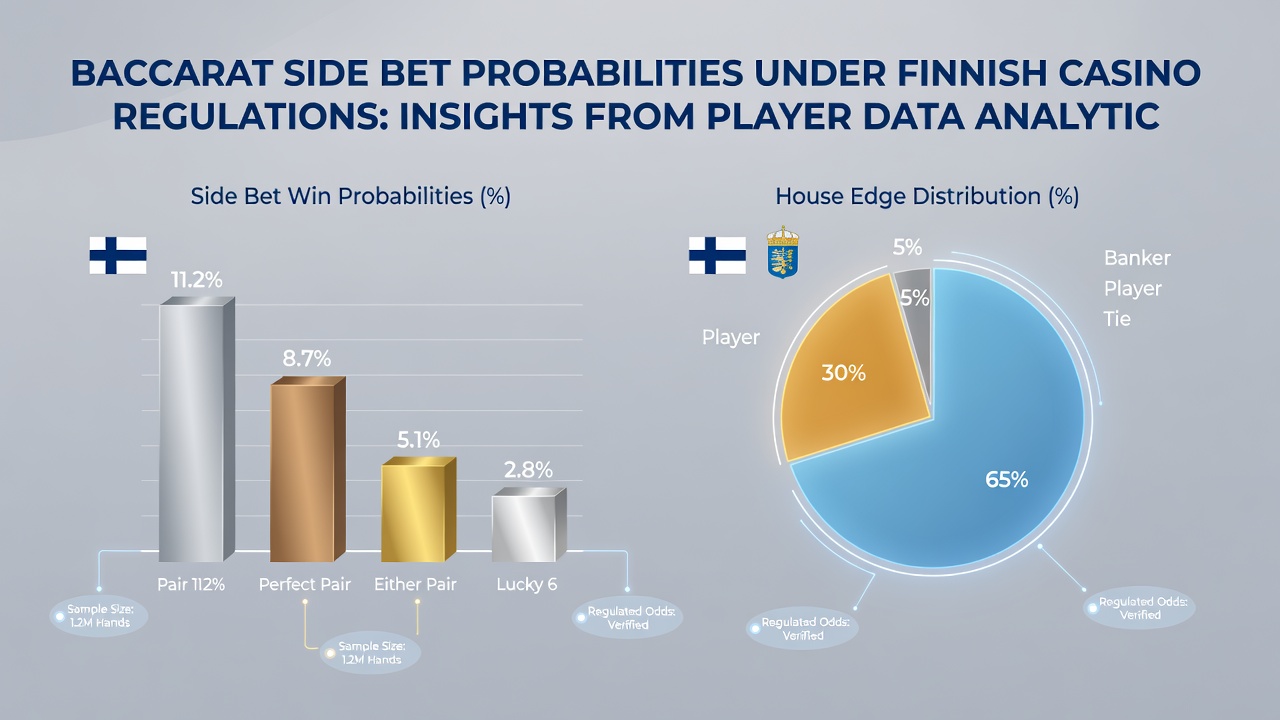
One dataset compiled from multiple licensed sites revealed that Tie bets, despite their higher house edge of 14.36 percent, accounted for 18 percent of all side bet volume during evening sessions. Pair bets, carrying a 10.36 percent house edge, captured 62 percent of side wager activity, while Dragon Bonus and similar options filled the remaining share. These proportions remained stable across different shoe compositions, suggesting that Finnish players respond more to payout size than to subtle differences in probability.
Player Behavior Patterns from Aggregated Data
Analytics tools segment Finnish player data by session length and bet frequency, showing that individuals who favor side bets tend to extend play duration by an average of 12 minutes compared with those who stick to main bets. Researchers at the University of Tampere examined anonymized transaction logs and found that side bet participation peaks between 8 pm and midnight, with probability calculations embedded in responsible gaming pop-ups that display expected value information. Such interventions have produced measurable shifts in bet distribution without altering the underlying probabilities themselves.
Cross-border comparisons with data from other European jurisdictions indicate that Finnish players place fewer high-variance side bets per session than their counterparts in less regulated markets. This pattern aligns with mandatory loss-limit tools that Finnish operators must activate by default. The resulting datasets therefore offer a controlled view of how probability information influences decision-making when presented alongside regulatory safeguards.
Regulatory Updates and Future Data Integration
Upcoming changes scheduled for August 2026 will expand the scope of analytics required under Finnish rules, including mandatory tracking of side bet sequences across consecutive shoes. Operators will need to feed these sequences into centralized databases that academic researchers can access under controlled conditions. Early pilot programs already demonstrate that sequence-level analysis can identify deviations from expected probability distributions caused by finite deck depletion, although the magnitude of these shifts remains within the margins predicted by combinatorial mathematics.
Industry reports from the European Gaming and Betting Association highlight how Finnish data standards have influenced similar frameworks in neighboring countries, creating opportunities for comparative studies on side bet performance. European Gaming and Betting Association reports document parallel trends in payout ratios and player engagement metrics across multiple jurisdictions.
Conclusion
Player data analytics under Finnish casino regulations provides a precise record of how baccarat side bet probabilities manifest in live play. Fixed mathematical rates for pair bets, ties, and bonus wagers continue to match observed outcomes, while regulatory reporting requirements generate datasets that researchers use to examine behavioral responses. As August 2026 approaches and new data fields come online, the granularity of these insights will increase, offering clearer pictures of probability in action without any alteration to the underlying odds themselves.